Sound & Interaction — DSP · Frontend · Audio programming
↗ RepositoryReverbo
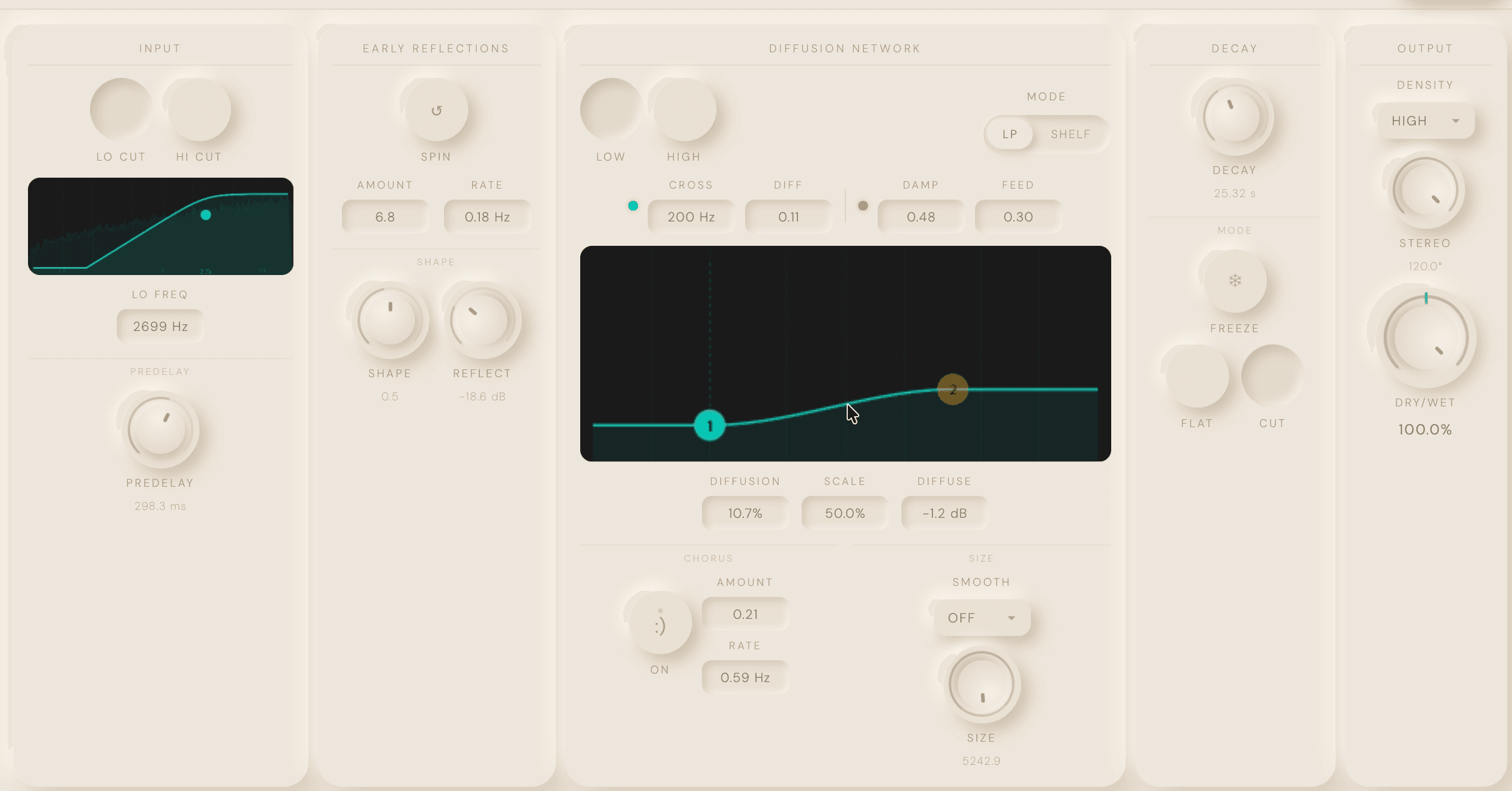
Stereo FDN reverb plugin with interactive filter graph and diffusion XY pad — built in C++17/JUCE with a Svelte UI.
C++17JUCE 8Svelte 5TypeScriptWebView
Work in progress
How it works
Svelte UI
(WebView)
(WebView)
Message passing
Audio InAudio Out
JUCE DSP
- Input Filter
- Early Reflections
- FDN Reverb
- Chorus
- Stereo Widener
Performance
| Format | VST3 / AU |
| Channels | Stereo |
| Parameters | 31 |
| Architecture | 8-line FDN + diffusion |
| UI | Svelte 5 / WebView |
| DSP | C++17 / JUCE 8 |
| pluginval | Pass (strictness 5) |
Context
Built for the Audio Programming class at MAT. Most audio plugins use native C++ GUIs — Reverbo separates concerns: DSP runs in C++/JUCE on the audio thread, the UI runs as a Svelte web app delivered via WebView on the message thread. No shared mutable state between them.
Technical Detail
- —8-line FDN reverb in C++17 / JUCE 8: Hadamard feedback matrix, 4-stage Schroeder allpass diffusion, early reflections with spin modulation, crossover filter for frequency-dependent decay, chorus, stereo widener, and dry/wet mixer — 31 parameters total.
- —Svelte 5 UI in WKWebView with an interactive FilterGraph (drag to adjust hi-cut frequency and Q) and a Diffusion Network XY pad (crossover × diffusion, damping × feedback). JS-to-C++ via URL-scheme interception; C++ pushes deltas at 30 Hz.
- —10 ms exponential smoothing on continuous parameters. Smooth mode selector (Off/Low/Med/High) adjusts ramp time for decay, reflect gain, and diffuse gain.
- —Passes pluginval at strictness level 5 (VST3). Builds as VST3, AU, and Standalone.
Learnings
- —Separating interface concerns from processing concerns makes both easier to reason about. This pattern transfers directly to any system with real-time constraints.
- —Smooth parameter transitions matter — abrupt knob changes create audible artifacts. The 10 ms exponential ramp was the minimum needed to eliminate clicks.